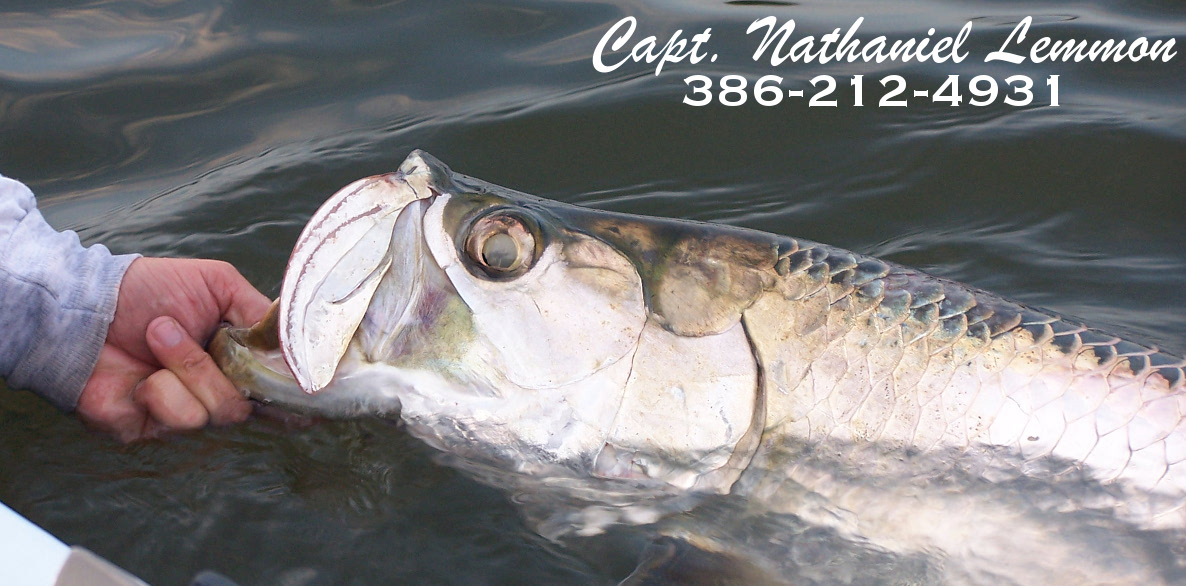


Tarpon Identification
Megalops atlanticus, otherwise known around Florida as the “tarpon.” These large fish are easily recognizable due to their size and coloration. Tarpon have huge silver scales, a greenish or dark blue back, a large upward opening mouth, a forked caudal fin, and a dorsal fin that extends into a long filament.
Tarpon are one of a few fish to possess a swim bladder that acts and serves as a lung, allowing tarpon the ability to breathe air from the atmosphere. They take in this air by “rolling” at the surface and gulping the air with an open mouth. This swim bladder is an important survival tool for juvenile tarpon. After spawning offshore, the newly hatched tarpon larvae return 30-45 days later (about 1 inch long) to inshore waters where they take up residence in ditches, retention ponds, canals, etc. Because these waters are stagnant and oxygen depleted, natural enemies are few and far between. Yet juvenile tarpon are able to survive because they can breathe air from the atmosphere.
An adult male tarpon can live over 30 years, while adult females can live to be over 50-years-old. Generally a 100 pound tarpon is about 13-16 years-old. Adult tarpon can grow to tremendous sizes. The Florida state record tarpon was caught in Key West and weighed a whopping 248 pounds The current all-tackle world record tarpon weighed over 286 pounds and was caught off the coast of Africa. For the most part tarpon have no value as table food. In 1989, Florida enacted a $50 kill tag and imposed a two fish harvest limit per day. Few of these permits are ever sold, and most tarpon are primarily catch-and-release fish. The best times to fish for and get a photo of a Tarpon that you catch in the Mosquito Lagoon, Indian River Lagoon or the New Smyrna Beach Ponce Inlet area is May through September.
Where to Find Tarpon
Tarpon are ancient creatures, having survived for several million years. Tarpon are found in warm saltwater all over the world. Specifically in the United States they range from Virginia down the Atlantic to the Florida Keys, and up and around the Gulf down to Texas. Their largest concentrations are found in South Florida and the Caribbean. Locally tarpon can be found in the Mosquito Lagoon, Indian River Lagoon, creeks and channels near Ponce Inlet and along local area beaches. Regardless of where you fish for tarpon, they are one of the most prized and sought after game fish.
Juvenile tarpon that live in the Mosquito Lagoon, Indian River or near Ponce Inlet, go through rapid periods of early growth. Once tarpon grow to about two feet in length, they move from their first homes in ditches, creeks, etc and seek out shelter in the open Lagoons, bays, channels, residential canals, and Intracoastal Waterway. They primarily can be found eating small baitfish, fish, crabs, shrimp and other crustaceans. Upon reaching sexual maturity at 7-13 years-of-age they join other adult tarpon that migrate up and down the coast of Florida. Males at this time weigh about 40 pounds and the females are close to 60 pounds (about 4 feet in length). Tarpon can reproduce for up to 45 years once sexually mature releasing up to 12-20 million eggs each spawn.
Fishing for Tarpon in Florida
It's one thing to catch a tarpon in the Mosquito Lagoon, Indian River or around New Smyrna Beach; it's entirely another thing to actually land that fish. Tarpon are known for their initial jumps, their acrobatic displays in the air and their powerful runs. Even a big tarpon weighing in over 100lbs is easily able to clear the water by several feet during their jumping displays. Tarpon can be caught on various types of gear. Sight fishing tarpon around New Smyrna Beach/Ponce Inlet or in the Lagoons consists of finding small schools of rolling tarpon with the occasional laid up fish. Tarpon are then caught on heavy spinning rods using soft-plastics, jigs, plugs or live bait. In New Smyrna Beach and around Ponce Inlet, anglers fishing for tarpon have success using live pinfish, mullet, crabs, or shrimp. Fights often last 10-20 minutes until the Tarpon is landed. Fly fishing Mosquito Lagoon and Indian River Lagoon tarpon is more challenging because you seldom find laid up fish. Fly anglers are usually casting sinking lines to rolling fish in tidal waters. In some smaller remote backwaters of the Mosquito Lagoon or Indian River Lagoon Tarpon are better targeted on fly because of the small fly sizes and the subtle and light presentation. Flies that resemble minnows or shrimp are top choices.
Tarpon are year-round residents in the New Smyrna Beach/Ponce Inlet area, Mosquito Lagoon, and Indian River Lagoon. Juvenile tarpon in the 5-40 pound range can be found during every month. During the summer, Ponce Inlet becomes a highway for big tarpon over 60 pounds as they push into area backwaters around Daytona Beach, New Smyrna and south into Mosquito Lagoon. During calmer mornings on warm days, these big tarpon can be found laid up or rolling in deeper bays, creeks, and the Intracoastal Waterway. If the ocean remains warm all summer, most of the tarpon will stay out in the ocean along New Smyrna Beach, Daytona Beach and Ormond Beach harassing bait pods just beyond the breakers. Local tarpon fishing can be a year round event, catching success is dependent on weather and prevailing water temperatures.
Capt. Nathaniel Lemmon is a full-time tarpon guide who specializes in fishing charters for tarpon on the Mosquito Lagoon, Indian River Lagoon, Spruce Creek, and around the Ponce Inlet backcountry. While big tarpon are only around during the summer and early fall, small baby tarpon under 10 pounds can be found any month. Tarpon fishing charters run daily from any one of several launch locations within easy driving distance of New Smyrna Beach, Ponce Inlet, Daytona Beach, Edgewater and Titusville.
Follow Nathaniel Lemmon


