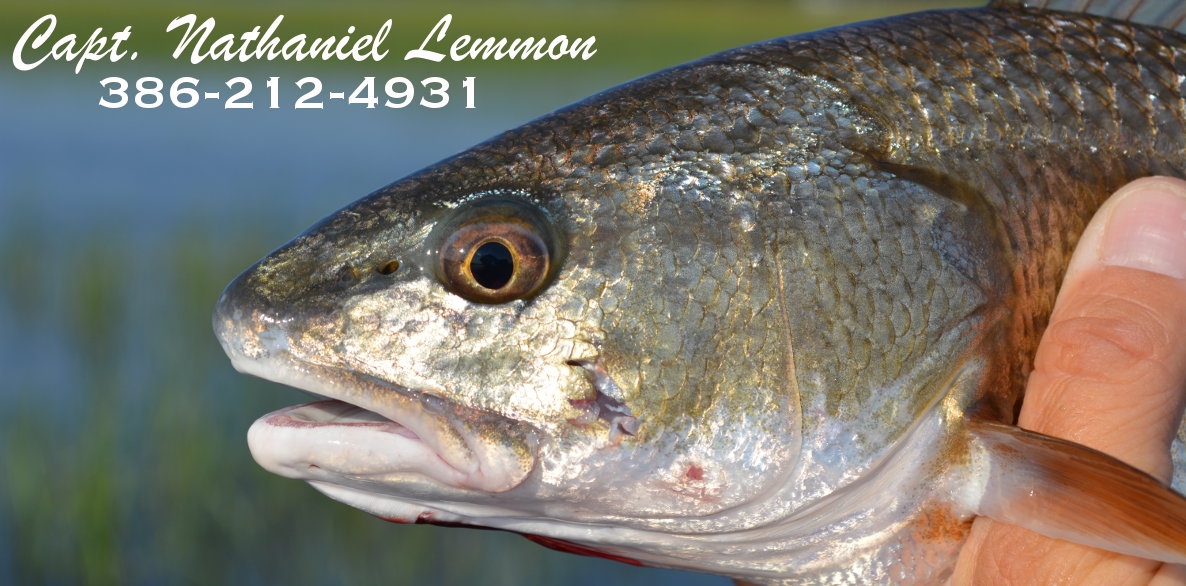


Redfish Identification
Sciaenops ocellatus, better known around Florida as the “Redfish.” They are members of the drum family and are close cousins to the sea trout, black drum, and croaker. When looking at a picture of a Redfish you will see a prominent large black spot on the tail, they will be copper/bronze in color and have large scales. Depending on water quality, they can appear lighter in color. Depending on their genetics, they may also have multiple spots on their tail and body. Rarely does the redfish have zero spots on their tail.
Primarily spending the early years of their life inshore, redfish find homes in estuaries, bays, and brackish waters. During the first year of their life, redfish reach about 12 inches in length and weigh approximately one-two pounds. Young redfish feed mainly on crustaceans like small shrimp and crabs, with the occasional baitfish and worms they find burrowed in the bottom. As they move into their second year of life they increase their size to about 20 inches and weigh approximately two-three pounds. As they grow bigger their diet changes very little in terms of food, but rather, the size of baits consumed. A three-year-old redfish will be in the mid 20 inch range and weigh approximately four-six pounds. Upon reaching sexual maturity, about 4 years old and approximately 30 inches in length, redfish migrate to offshore waters to live out the remainder of their life. They return each fall to spawn in the inlets, passes and bays linking the inshore and offshore waters.
Adult redfish can live a long time, with large breeders reaching ages between 20-30 years-old. Large adults can reach lengths over four feet in length and weigh upwards of 50-60lbs, if not much more. The current Florida state record for a redfish is 52lbs and was caught along the east coast of Florida in Brevard County. The current all-tackle world record redfish weighed over 94lbs and was caught along the Outer Banks of North Carolina. Florida maintains a "slot-limit” that permits anglers to harvest one redfish per-day that is between 18-27 inches in length. This rule was established to protect them as a desired game-fish and to save breeder redfish from harvest.
Where to Find Redfish
Redfish can be found all along the coast, stretching from Texas, around the Gulf to Florida, and up the Atlantic to parts of the Northeast, preferring water temperatures between 65-85 degrees. In other parts of the coastal United States you may here redfish referred to as red drum, spot tail, reds, puppy drum, channel bass, etc. Regardless, the redfish is an extremely popular game-fish which gains more and more notoriety each year.
Redfish generally are bottom feeders (depending on their sense of smell to find food) and often times are found “tailing” on the flats. This behavior is exhibited when a redfish tilts down to pick up something off the bottom and their tail rises above and out of the water surface. They are often found working shorelines, grass flats, transition points of deep water to shallow flats, sandbars, hovering over sandspots/potholes, oyster bars, at creek mouths, etc.
Fishing for Redfish in Florida
Redfish can be caught fishing in Florida on various types of fishing gear. They are often caught using spinning rods; tossing soft-plastics, jigs, top-water plugs, spoons, crankbaits, etc. Recently they have also become a favorite of fly fisherman throwing shrimp, crab, and baitfish patterns. They can be routinely caught anytime using live or cut bait such as shrimp, mullet, crabs, etc. Sight fishing for redfish is popular because it is much like hunting and because their fights are often long, tackle testing, and drag screaming. After catching a redfish, fights can last 30 minutes to an hour.
Most adult redfish move offshore to join and live out their life with the other breeder fish, but there is one place in the world where the big adults generally don't leave and give anglers an opportunity to sight fish these big reds year round...the Indian River and Mosquito Lagoon. Big bull redfish in the Indian River Lagoon is unique, world class, and now well known. It's a chain of waters that include the Indian River, Mosquito Lagoon and Banana River. Places like New Smyrna Beach, Oak Hill, and Titusville have earned “5-star” status when it comes to sightfishing big redfish. Whether it is on TV, in the newspaper, or in major magazines, the local area receives its fair share of national press, is dubbed as the "Redfish Capital of the Florida," and has played host to numerous line-class redfish world records. Each year nearly 700,000 people come from all places to visit Florida, mostly for one reason, GIANT redfish.
Capt. Nathaniel Lemmon is a full-time redfish guide who runs fishing charters for redfish on the Moquito Lagoon, Indian River Lagoon, and around the Ponce Inlet backcountry. Light tackle and fly fishing charters for redfish are world renowned on these inshore flats for because of the crystal clear water and numerous shots to sightfish redfish. It's not uncommon to see over 1,000 Mosquito Lagoon redfish in a day. Trophy Redfish fishing charters run daily from one of several launch locations within easy driving distance of Daytona Beach, New Smyrna Beach and Titusville.
Follow Nathaniel Lemmon


